In a long hall near the Grand Palace stand the funeral chariots of the kings, gilded, many metres tall, built to carry a royal body to the cremation ground with several hundred men on the ropes. They are among the largest objects in any museum in Southeast Asia, and they sit in a room where the lighting is poor and the labels are thin, which is a fair summary of the National Museum as a whole: extraordinary things, indifferently displayed.
Most of these museums close on Mondays, including the National Museum and the Museum of Siam. The free volunteer-led tours at the National Museum run only on set days and are worth planning the week around, so check the schedule before you fix anything else.
IThe Palace That Became a Museum
The National Museum began as a royal collection. King Chulalongkorn opened it to the public in the 1870s, and it later moved into the compound of the Front Palace, the residence of the deputy king, an office allowed to lapse in the 1880s and never filled again. The building is part of the exhibit: a palace whose purpose ended, filled with the objects of a court assembling a national past at the moment European powers were pressing in on Siam from every side. A kingdom that wanted to be recognised as civilised, and therefore left alone, needed the apparatus of one: a survey, a map, a chronology, and a collection of the things the chronology was made of. Sculpture that had been sacred property in provincial temples came to Bangkok and became national heritage.
What it holds is the full sweep, from Neolithic tools through Sukhothai and Ayutthaya to the Rattanakosin era: Buddhist sculpture by the room, royal regalia, weapons, textiles, the chariots. Little of it is interpreted for a newcomer. The volunteer docents, many of them long-resident foreigners who have studied the collection for years, turn it from a warehouse into a story, and their tours are free. Come for depth. Do not come for polish.
IIThe Avenue and the Hall
The Rattanakosin Exhibition Hall stands on Ratchadamnoen Klang, and the address matters more than anything inside it.
Ratchadamnoen was laid out under Chulalongkorn at the turn of the twentieth century, a European boulevard driven through the old city to link the Grand Palace with the new royal district at Dusit: a processional road, built for a monarchy to move along. After the revolution of 1932 ended absolute rule, the new government took the middle stretch and made it something else. The Democracy Monument went up at the centre of it in 1939, and long modernist blocks followed down both sides, uniform, low, deliberately unpalatial, turning a royal processional way into a civic street of cinemas, shops and offices for a public that was now supposed to be the point. It has been the city's ground for political demonstration ever since.
The Exhibition Hall occupies one of those buildings. Inside, across several floors of film, models and immersive display, it tells the story of the Chakri dynasty: the founding of the capital in 1782, the reigns, the court ceremonies, the royal arts. The presentation is excellent, the guides are good, and it is the clearest orientation to Bangkok's history available in the city. It is also the older narrative reinstalled in the building put up to replace it.
IIIThe Museum That Asks What It Means to Be Thai
The Museum of Siam opened in 2008, in a neoclassical former ministry building near Sanam Chai, and it was built around a question rather than a collection. Its permanent exhibition works through what Thainess consists of, and its answer is that it has no fixed content: that what counts as Thai has been assembled, argued over and revised repeatedly, borrowing from India, from China, from the Khmer, from Europe, from the market, and that it is still being revised now.
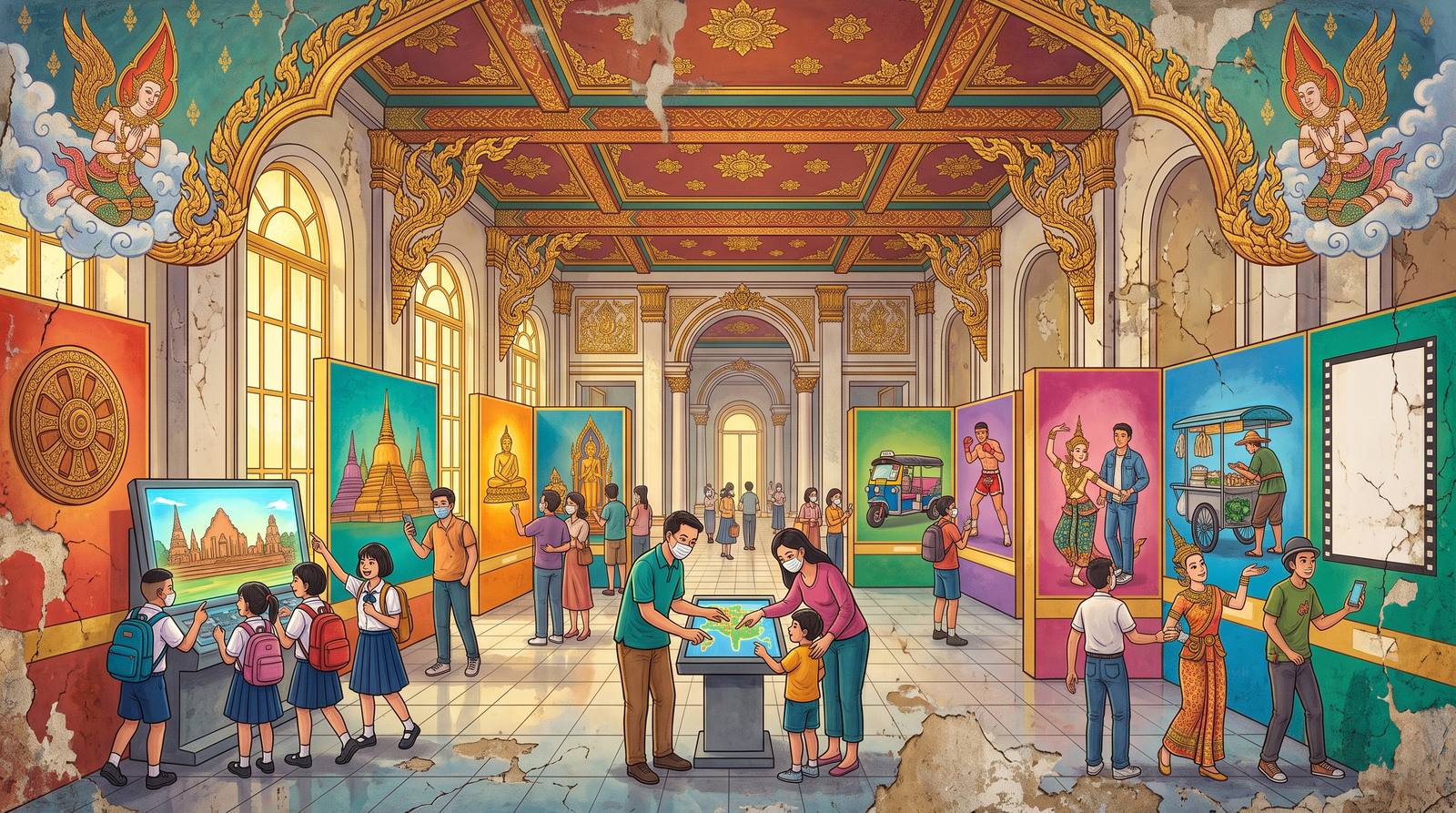
The galleries make the case in stages, from the trading kingdoms of the Suvarnabhumi era through Ayutthaya to the present, with games, films, costume and a virtual pad thai to cook. It is the most enjoyable museum in the city and much the best for children. It is also thin on objects, because the argument is the exhibit. Seen after the other two it changes how you read them: the National Museum shows a nation being assembled and does not say so, the Exhibition Hall tells one version with great conviction, and this is the one that treats the question as open.
IVThe Museum of the People Who Built It
None of the three above has much to say about work. The Thai Labour Museum, in a low former railway building at Makkasan, is the only place in the city that takes it as the subject.
Set up by trade unions and opened in 1993, it runs the same centuries from the other end: corvée service, under which commoners owed the crown months of labour a year; the Chinese migrants who dug the canals, built the roads and worked the docks, and who brought the first strikes with them; the ending of slavery under Chulalongkorn, gradual and legislated across decades; the railway and tram workers; the women who came from the countryside to the textile factories; the unions of the 1970s, their brief opening and their closing. The rooms are plain and the displays homemade, and the whole thing was assembled by the people it is about.
Its centre is the Kader fire. On 10 May 1993 a toy factory outside Bangkok burned with the exits blocked, and 188 workers died, most of them young women from the provinces. It remains the deadliest factory fire on record anywhere, and the date is now the country's day for workplace safety. The memorial here is the reason the museum exists.
Admission is free, the opening days are limited, and the museum has spent much of its life short of money and secure premises, so check before you go. Forty minutes is enough, and it will reframe everything else on this list.
VSilk and the Court
The Queen Sirikit Museum of Textiles occupies a restored 1870s building inside the Grand Palace walls and opened in 2012. It is small, air-conditioned and rather beautiful, and the story it tells runs in three movements.
The first is trade. For centuries the finest cloth in Siam arrived by ship: painted cottons from the Coromandel coast, patterned silks from Gujarat and China, much of it ordered to Siamese design and reserved by custom for the court and those the court favoured. Cloth was rank, and rank was imported.
The second is manufacture. Sericulture was pushed as state policy from the turn of the twentieth century, and after the Second World War the trade turned outward: Thai silk became a luxury export, associated above all with Jim Thompson, woven in Isan villages and sold in New York and Milan. A cloth once bought from abroad was now made at home and sent abroad, and its prestige came back with it.
The third is dress. Under Phibun's cultural mandates in the 1940s Thais were instructed to dress in the Western manner as a mark of a modern nation. Two decades later, ahead of a series of state visits, eight styles were drawn from nineteenth-century court costume and given royal endorsement: chut thai phra ratchaniyom, dress in the royal preference. Worn first by the queen abroad, then by the court, then by officials and at weddings, it became the national dress of a country that had not previously had one, and is now worn by anyone who can afford it.
The SUPPORT foundation, through which the late Queen Sirikit set out to revive hand weaving as a rural livelihood rather than a heritage display, is that third movement's practical arm: the villages that supplied the cloth given a reason to keep making it. Your Grand Palace ticket includes the museum.
VIThe Barges
In a shed on the Bangkok Noi canal sit the royal barges, carved from single teak trunks, their prows worked into the Suphannahong swan and the naga and the garuda, gilded and set with glass. They go out only rarely, for royal ceremonies that may be years apart, and the rest of the time they lie in half-light with their oars stacked beside them. A barge procession is one of the most spectacular things the Thai state does, and it is done so seldom that most people in Bangkok have never seen one.
Three quarters of an hour is enough, and the approach through the narrow lanes and along the canal walkway is half the pleasure. There is a separate and higher admission for foreign visitors, worth knowing before you arrive rather than at the window.
VIIA House in Bang Rak
The Bangkokian Museum is three preserved houses in a garden off Charoen Krung, given to the city by the family who lived in them, and it is free. The rooms are laid out as a middle-class Bangkok household kept them in the middle of the last century: the kitchen, the parlour, the medicine cabinet, the beds. Volunteers will walk you through the family's history if you would like them to. Nothing here is national, no argument is being made, and after a week of dynasties and regalia that is the museum that will stay with you longest.
VIIIOne at a Time
These are not museums to string together. The National Museum alone will take a morning and leave you tired, and the rest reward a slow visit and a long lunch rather than a second ticket. Take one, and pair it with something small and close by.
The National Museum sits beside Wat Mahathat, with the river at Tha Chang a few minutes away. The Rattanakosin Exhibition Hall has the Democracy Monument outside its door and Loha Prasat, the metal-spired hall at Wat Ratchanatdaram, a short walk along the avenue, with the Golden Mount beyond it for the end of the afternoon. The Museum of Siam is ten minutes from Wat Pho in one direction and the flower market at Pak Khlong Talat in the other. The Royal Barges come with the Thonburi lanes you walk through to reach them. The Queen Sirikit Textiles collection is its own pairing, standing inside the Grand Palace walls. The Bangkokian Museum belongs to a Charoen Krung afternoon, with the antique shops and old shophouses on either side of it.
The Thai Labour Museum has nothing much around it, which suits it. Forty minutes, then the Airport Rail Link from Makkasan and the rest of the day to think about it.
Most cost around a hundred baht, several cost nothing, and all of them are better with a guide than without one.