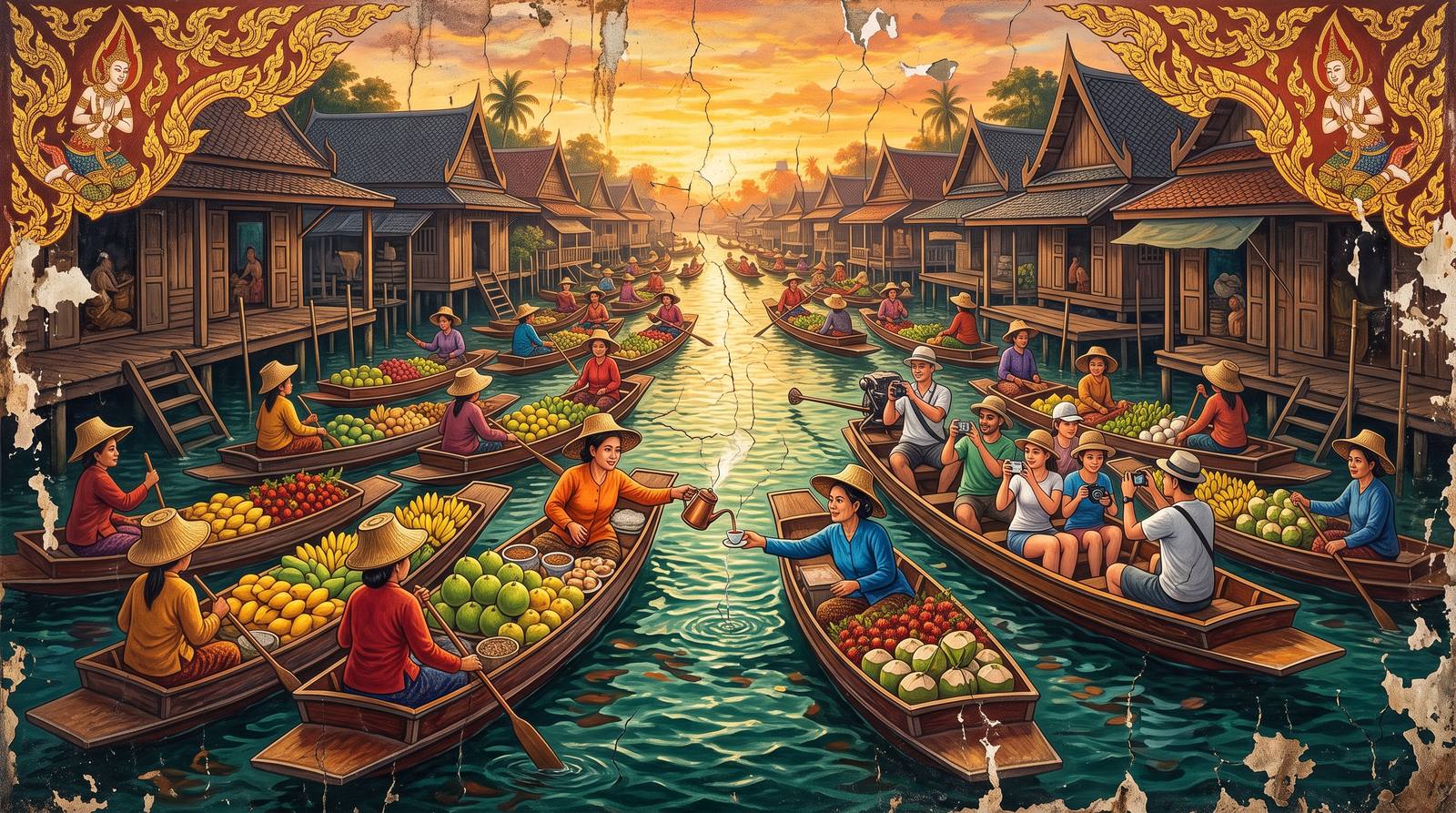
For most of Bangkok's history you bought your food from a boat. The city sat on a delta cut through with khlong, canals, and the canals were not scenery but streets. A household took its rice, fish, fruit and charcoal from vendors who came to the landing at the end of the garden, and the larger trade gathered where the waterways met, hull against hull, in the dark hours before the heat arrived. The work was done mostly by women, paddling from the stern, one hand free for the money, and it began early enough that the first business of the day was often coffee sold from a passing boat to people still waking up on theirs.
Out in the provinces the same pattern ran wider and slower. The Damnoen Saduak canal was cut in the 1860s, in the reign of King Mongkut, driven more than thirty kilometres across the plain to link two rivers and open the land between them to rice. It was dug by hand and it was one of the great engineering works of its age. The market that grew along it did not have to be founded. It simply happened, because the boats were already passing and the fruit had to go somewhere.
Damnoen Saduak is worth seeing only before eight in the morning. Amphawa runs from Friday to Sunday and belongs to the evening. Khlong Lat Mayom and Taling Chan, on the western edge of the city, open at weekends only. Arrive on a Tuesday afternoon and you will find a canal, some shuttered stalls and no market at all.
IWhat the Roads Took
The highways came in the 1950s and the trade went with them. Trucks reached the orchards directly, the wholesale markets moved onto land, and within a generation the boats had lost their purpose. Bangkok, meanwhile, was filling in its own canals as fast as it could. A city built to move on water decided its future ran on wheels, and street after street in the centre is a khlong that was covered over and forgotten, which is one reason the place floods as it does.
The floating markets did not so much close as become pointless. There was no dramatic ending: a few boats fewer each season, then a morning when nobody came. What went with them was not only a way of trading but a way of living close to the water, in wooden houses raised on stilts, with the day organised around a tide. By the end of the 1960s that world had thinned to almost nothing, and the people who remembered it working were already old.
IIThe Market That Was Brought Back
In 1971 the state tourism body revived a fading market on the Damnoen Saduak canal and promoted it to foreign visitors. Thailand was building a tourist industry in earnest, and the floating market offered something no other country in the region could match: an image at once exotic, photogenic and, until very recently, ordinary.
It succeeded beyond anything intended, and the whole category was rebuilt in its image. Some old markets were restaged for visitors. Many more were made from scratch, and most of those were aimed not at foreigners at all but at Thai families looking for somewhere pleasant to eat at the weekend. The markets you can visit today were made at different times, by different people, for different customers, and that is the useful thing to know about each one.
IIIThe Market Built for Visitors
Damnoen Saduak is the postcard and the origin of the modern idea. Most boats sell souvenirs rather than produce, prices are set for visitors and settled by haggling, and the morning runs on package tours arriving from the city in convoy. Come before the coaches, agree every price before you accept anything, and expect a queue on the water by mid-morning.
The fruit really is stacked that beautifully, the hats really are that wide, and the light on the water at seven is worth the drive on its own. What you will not find is anybody doing their weekly shop.
IVThe Weekend Town
Amphawa is the one most Thais would send you to. A riverside town of nineteenth-century shophouses, its market threads along the canal at dusk, and its signature is seafood grilled on the boats themselves and handed up to you at the water's edge as the light goes. Afterwards the long-tails run out along the river to see fireflies in the lamphu trees on the bank, hundreds of them pulsing in the branches.
Amphawa was a trading town long before it was a destination, and it still works as a town: families in the shophouses, temples along the water, a rhythm that carries on when the visitors leave. It is also busy, and the stalls nearest the bridge could be anywhere. Saturday is heaving. Go on the Friday.
VWhere Bangkok Eats
Khlong Lat Mayom, under an hour from the centre, is a weekend food market beside a canal, and it is the better of the western pair. Boat noodles, hoi tod, kanom jeen, grilled river prawn, fruit ice creams: all of it eaten at canalside tables by families who have come for lunch, at prices set for them. A modest boat runs through the orchard canals behind it, past durian and pomelo groves that have been worked for generations, and it is a quiet hour well spent.
Taling Chan, close by, is similar in spirit, built around floating platforms where you choose a fish to be grilled, with folk music playing and a long-tail tour on offer. Both markets sell from the bank rather than from boats, and both are busiest with Thai families at Sunday lunchtime.
VIThe Green Loop
Bang Nam Phueng sits inside Bang Krachao, the jungle-covered loop of land the river throws around itself opposite the city. A short ferry gets you there and a rented bicycle is the way to see it, along raised concrete paths that run through banana and coconut above the wet ground.
The market itself is a community weekend market near the water rather than on it: street food, snacks, crafts, warm vendors and almost no hard sell. Bang Krachao was never built over, so the houses still stand on stilts among the orchards and the whole loop keeps the pace the water sets.
VIIThe House on the Canal
Khlong Bang Luang is not a market in the trading sense at all. A two-hundred-year-old wooden house on the canal works now as an artists' space and café, with traditional puppet performances, workshops and a few stalls along the water.
Sit on the deck for an hour and you get the things a market cannot give you: the scale of the houses, the closeness of the water, the way a canal community sat, facing the khlong with its back to the land, because the front door was the one that opened onto the boat.
For the photograph and nothing more, Damnoen Saduak, early and guarded. For an evening and fireflies, Amphawa on a Friday. For the best eating, Khlong Lat Mayom. For quiet and a bicycle, Bang Nam Phueng. For the shape of the old life, Khlong Bang Luang.