Kanchanaburi's map quietly unlocks the cosmological. Its most beautiful waterfall is named for the elephant who carries a god across the heavens; its most famous walk is named after hell. Nobody planned this. The names were given by different people, decades apart, for different reasons, but together they inscribe onto one river valley the oldest diagram in Thai thought: paradise above, suffering below, and a forest in between. That forest is real. This is one of Thailand's greatest natural regions, a landscape of jungle-clad limestone hills, emerald rivers, vast reservoirs and some of the finest waterfalls in the country, much of it protected within a chain of national parks belonging to the immense Western Forest Complex, the largest contiguous wildland in mainland Southeast Asia. Whether you want to swim beneath a turquoise cascade, drift to sleep on a river raft, or simply breathe forest air far from the city, here is how to commune with nature in Kanchanaburi.
The Jewel: Erawan Falls
The region's natural icon is Erawan Falls, the centrepiece of the Erawan National Park, about ninety minutes from town, and for many the most beautiful waterfall in Thailand. It descends through seven tiers of limestone, each forming pools of an unreal emerald-turquoise, the colour coming from the mineral-rich water. Erawan is the Thai name for Airavata, the many-headed white elephant who carries the god Indra across the heavens, and the topmost tier is said to resemble his three great heads. In the classical Thai imagination, waters like these belong to Himavanta, the paradise forest at the foot of the cosmic mountain, painted on temple walls across the country: a wilderness of healing pools and marvellous creatures. Climb the seven tiers and you are walking, whether you meant to or not, a small ascent toward heaven.
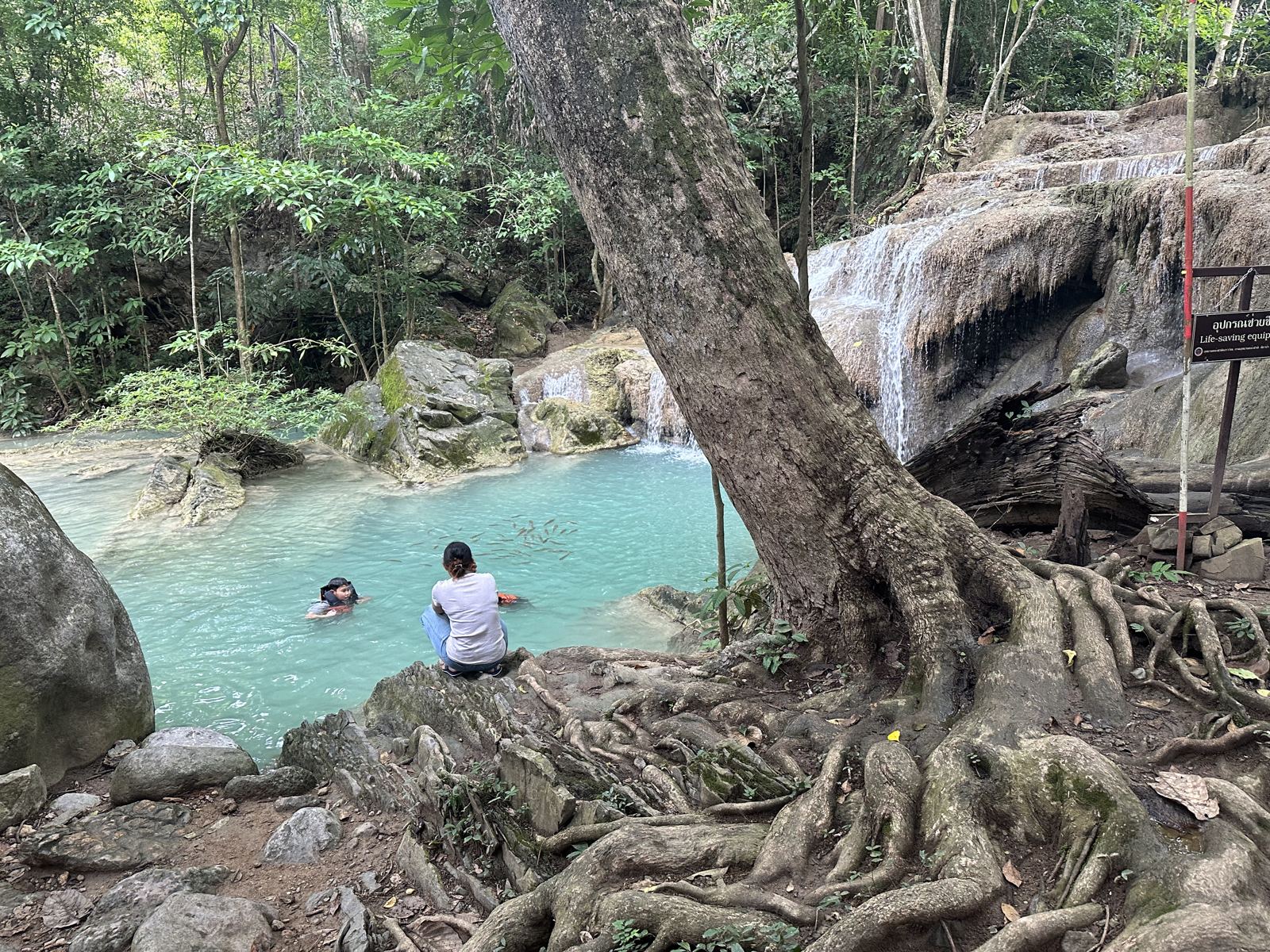
The practicalities are earthier. A well-made two-kilometre trail climbs alongside the cascades through the forest; the lower tiers are easy and spacious for swimming (the little fish will nibble your feet), while the upper levels five to seven are a steeper, rockier scramble rewarded with quieter, wilder pools. Go early to beat both the heat and the crowds, wear proper shoes, and carry water up. It can get busy at the lower pools, but it earns its fame.
The Quieter Equal: Huai Mae Khamin
For the same beauty with a fraction of the people, the secret is Huai Mae Khamin Waterfall, deeper into the forest in Srinakarin Dam National Park, around an hour beyond Erawan. Also seven-tiered, also emerald-pooled, it is wider, gentler to walk and gloriously uncrowded; visitors regularly report having whole tiers almost to themselves, passing only a handful of others in hours. Many who see both quietly prefer it. The murals promise a paradise forest empty of everyone but hermits and marvellous beasts, and of the two, this is the one that keeps the promise. The trade-off is simply the distance and rougher road, but for anyone whose idea of communing with nature requires actual solitude, this is the one to choose.
"Paradise above, suffering below, and a forest in between."
Life on the Water: The River and the Lake
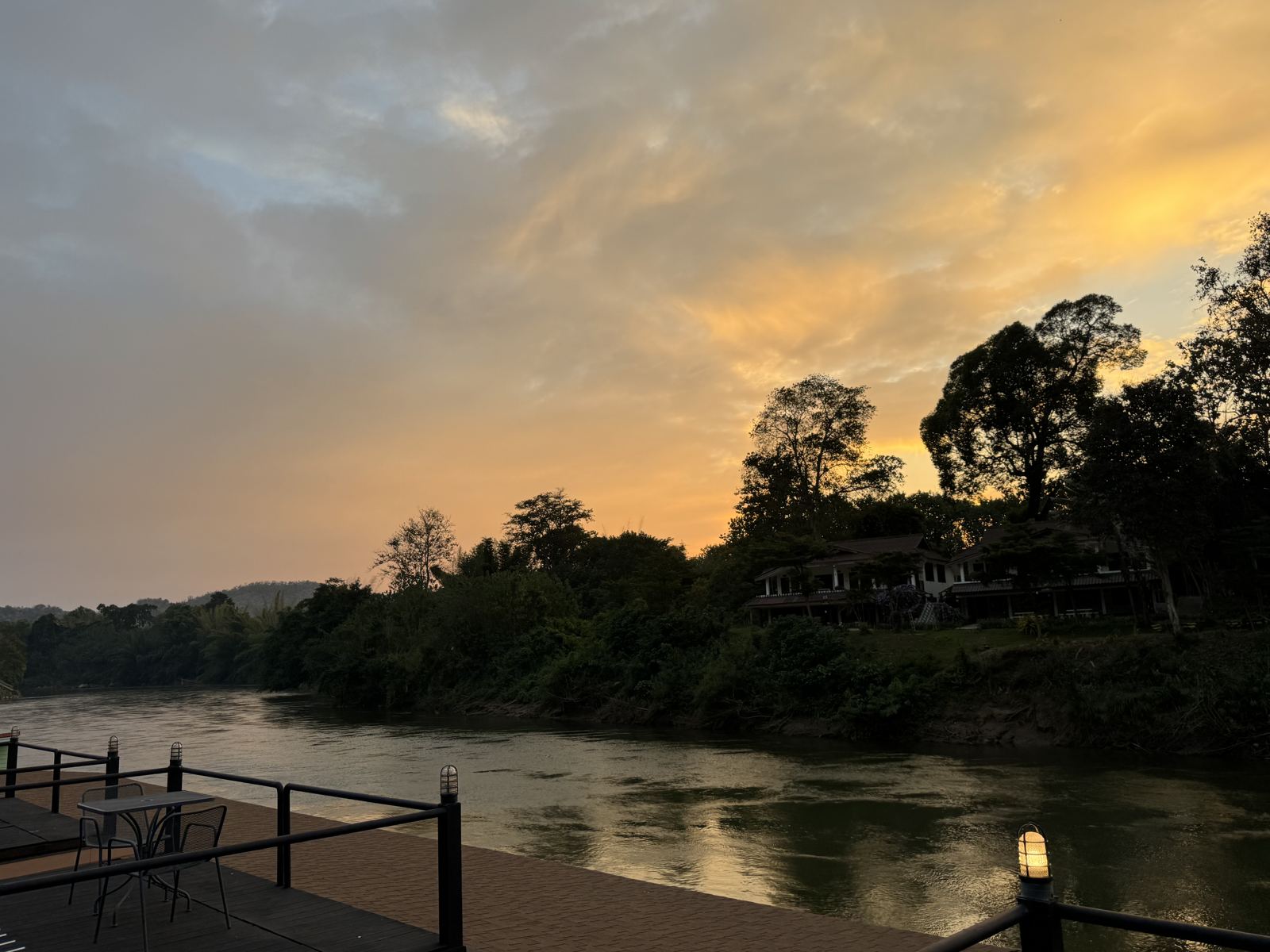
Kanchanaburi's soul is its water. The River Kwai (Khwae Noi) is the heart of its slow pace of life, and the classic way to surrender to it is a night on a floating raft house: simple bamboo rooms moored to the jungle bank, where you wake to mist rising off the water and watch the river drift past from your deck. Upriver, the immense Srinakarin Dam holds back a spectacular jade-green reservoir ringed by mountains, where boat trips, kayaking and lakeside raft-house stays offer a wide-open, serene counterpoint to the intimacy of the river. Sunset over the lake, from the water or a hillside deck, is one of the region's great quiet pleasures.
Forest and Caves: Sai Yok National Park
West of town, Sai Yok National Park spreads across nearly a thousand square kilometres of the Khwae Noi valley, a gentler, less-trodden park ideal for those who want nature without a punishing trek. Its signature is Sai Yok Yai Waterfall, which tumbles directly off a cliff into the river itself, best seen from the park's suspension bridge or by chartering a long-tail boat to nose right up to the falling water. The park also shelters caves, forest trails through shaded bamboo, raft-house stays, and remnants of the Death Railway. Nearby, the dramatic Lawa Cave (Tham Lawa), the largest cave in the area, leads you down through chambers of stalactites and stalagmites; bring a torch, watch the slippery steps, and one of the friendly local guides at the entrance will show you the finest formations. It is also home to bats, which stream out at dusk.
For a more active way to get among the canopy, the Tree Top Adventure Park at the Home Phutoey resort in Sai Yok sends you ziplining, sky-biking and Tarzan-swinging across more than forty platforms strung high through the rainforest, with a finale zipline soaring the length of a lake. Built to European safety standards with guides accompanying you throughout, it suits families and adrenaline-seekers alike (minimum age ten, around 1.4 metres tall, maximum weight 100kg): a genuinely exhilarating way to experience the forest from above rather than below.
A Step into the Lower Realms
Some of the most moving nature here is inseparable from history. The Hellfire Pass Memorial Walking Trail leads through a deep rock cutting carved by Allied prisoners of war and Asian labourers during the Second World War, and it is also a genuinely beautiful trek through quiet, shaded bamboo forest. The name was given by the men who dug it. Working through the night by the light of bamboo fires and carbide lamps, gaunt figures swinging hammers against the rock, they looked down into the cutting and recognised a scene from hell. The name held. So the valley carries its full vertical map in two place names: the god's elephant at the head of the falls, the underworld on the railway line, names given by people who never met.
Walk the cutting in silence with the excellent museum audio guide. The birdsong and the rustling leaves fold into the weight of what happened here: nature and remembrance held together, a uniquely Kanchanaburi experience. In this region the forest and the past are never far apart.
How to Commune with Nature
Shape the trip around how deep you want to go. For the famous beauty, Erawan Falls (early, to beat the crowds); for solitude, make the longer haul to Huai Mae Khamin. For the slow water life, a river raft house or a stay on Srinakarin Lake. For gentle forest, caves and the cliff-into-river falls, Sai Yok. And for a walk that stirs the soul as well as the senses, Hellfire Pass. A few practical notes: national-park admission for foreigners is markedly higher than the local rate (Erawan is around 300 baht), and worth carrying cash for; sturdy shoes and water are essential for the falls; the parks open early and stop admitting visitors well before closing (often 3.30–4pm), so start your day early. One current caveat: the Department of National Parks online accommodation-booking system has been unreliable through the 2026 season, so if you hope to stay inside a park, arrange it directly by phone or through a local operator rather than relying on the website.
Above all, give the wild side of Kanchanaburi unhurried time. The old cosmology placed the healing forest partway up the mountain, above the worlds of suffering and below the heavens, and for once the geography agrees. To unlock more on Thailand's cosmology and the sacred landscape of Kanchanaburi, download the Siam Curated app — coming soon.