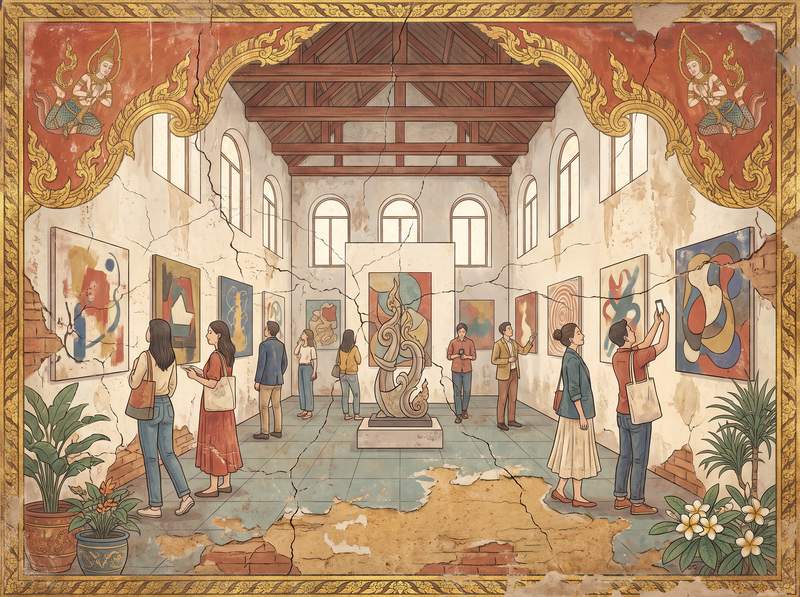
In the space of a few years Bangkok has become one of Asia's most compelling art cities. What was once a scattering of university spaces and commercial galleries has matured into a genuine ecosystem, and the last eighteen months have been transformative: two major new institutions that place the city firmly on the global art map. These are the ten spaces worth your time, from the headline-grabbing new museums to the quiet, long-running galleries that built the scene. One thing is worth knowing before you set out. For most of this country's history, there were no galleries, because there was no art in the gallery sense: images were made for temples, unsigned, their worth conferred by consecration rather than collection, and their beauty a way of describing the order of the cosmos. The modern apparatus (the academy, the exhibition, the artist as a name) arrived in the twentieth century, and its founding professor was an Italian: the Florentine sculptor Corrado Feroci, who took Thai citizenship, a Thai name, Silpa Bhirasri, and the title still given to him today, father of modern Thai art. Every room below works in the space that transformation opened, between an aesthetic of the sacred and a market of the new.
I · The New LandmarksRaw, and Long Overdue
The most significant cultural opening in Thailand for a generation arrived in December 2025. dib Bangkok, whose name means raw, or a thing in its natural, unfinished state, is the country's first museum dedicated to international contemporary art. Conceived by the late collector Petch Osathanugrah and realised by his son Purat, it occupies a converted 1980s warehouse near Sukhumvit Soi 40, redesigned by Kulapat Yantrasast of WHY Architecture. Across three levels, eleven galleries, a courtyard and a sculpture garden, it draws on a collection of more than a thousand works by over two hundred artists, among them Anselm Kiefer, Louise Bourgeois, James Turrell, Lee Bul, and the great Thai sculptor Montien Boonma. The inaugural exhibition, (In)visible Presence, runs through August 2026. The building is a triumph, and a Thai gallery of this quality is long overdue.
But it is also worth going with your eyes open. Much of the work here stages a dialogue between wealth and poverty, rich and poor, and it does so inside a tightly controlled and exclusive space: a stunning modernist building set behind a fence and a wall of watchful security on the edge of one of the poorer districts of the city. The museum has a dual-pricing system — common and understandable in a country where wages are low. Yet the ticket price remains well beyond the reach of most Thais, pointing to a tension the museum never quite resolves. Added to this is the name. dib, raw, carries the strong scent of the rural periphery, of Isan and the northern hills, of the unpolished country far from Bangkok, an odd word to fix above such a rarefied and exclusive space. It reaches further back too: in the older aesthetic economy, raw is what an image is before the blessing, before the rite that gives it worth. Here the rite has been performed, and the worth is measured at the ticket desk. The old and new economies of value share a wall, and neither quite admits the other is there. The art is genuinely world-class. But the frame is off.
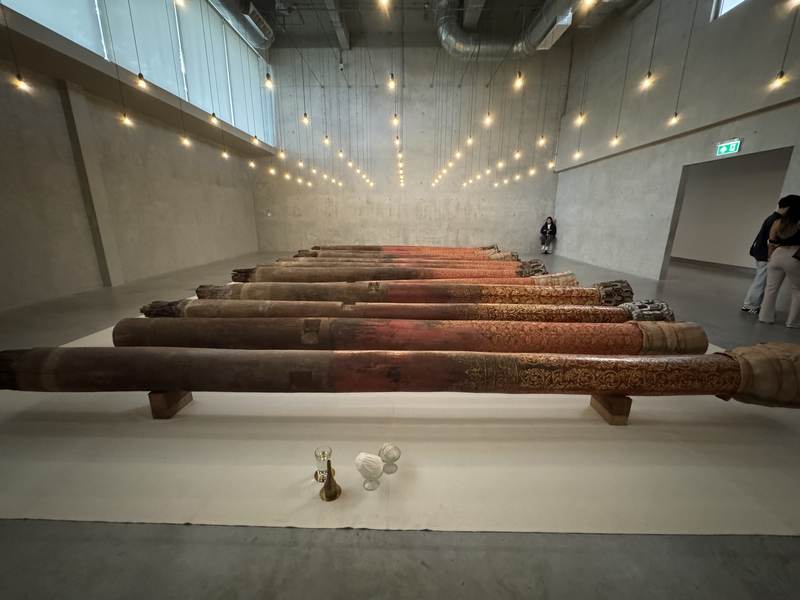
Equally important, and utterly different in spirit, is Bangkok Kunsthalle, which opened in January 2024 in a fire-damaged former printing house in Chinatown. Founded by the philanthropist Marisa Chearavanont and directed by Stefano Rabolli Pansera, it is less a polished museum than a living building reclaimed floor by floor through artist commissions. The raw concrete shell, deliberately left near-untouched, forces artists into bold, site-specific responses, and the result is the most exciting experimental space in the city. Admission is free, and the contrast with its wealthier cousin is instructive.
II · The Established InstitutionsThe Anchors
No tour of Bangkok's art scene is complete without its three anchor institutions. The Bangkok Art and Culture Centre (BACC), in the heart of Siam, remains the city's most beloved cultural hub. Its spiralling nine-storey atrium, an architectural landmark in itself, hosts rotating exhibitions, film, theatre, talks and workshops, and draws around half a million visitors a year. Entry is free, and it is a natural first stop, five minutes from BTS National Stadium.
Out in Chatuchak, the Museum of Contemporary Art (MOCA) is the grand statement of the genre: five floors and more than eight hundred works from the private collection of the telecoms magnate Boonchai Bencharongkul. It is the place to understand the modern Thai masters, Thawan Duchanee, Chalermchai Kositpipat, the staggering large-scale canvases of Prateep Kochabua: the generation that carried the temple wall onto the canvas, and spent their careers negotiating what could be borrowed from the sacred and what the sacred would forgive. The journey from the centre is longer, but the scale of the collection repays it.
The Jim Thompson Art Center, beside the famous silk magnate's house museum near Siam, offers a more intimate counterpoint. Its four-floor space pairs Thai and international contemporary artists in carefully curated shows, and the William Warren Library is a peaceful retreat in its own right. Entry to the Art Center is free.
III · The IndependentsThe Galleries That Built the Scene
Beyond the institutions, a handful of independent and commercial galleries form the backbone of the city's art life. SAC Gallery, tucked off Sukhumvit Soi 39, calls itself a leader in Thai contemporary art and has earned the claim: since 2012 it has staged more than a hundred exhibitions, often tackling heavy and provocative themes, and its residency programme cultivates young Thai talent. Bangkok CityCity Gallery, near Lumphini, is the cool, minimalist heart of the emerging scene, an early champion of artists who later broke into the mainstream and a sometime stage for experimental theatre. Both keep limited hours, so check before visiting.
In the creative riverside district of Charoenkrung, ATT 19 is one of the city's true hidden gems: a century-old former Chinese school, now a beautifully atmospheric showroom for sculpture, installation and Asian antiques, with a garden café and a sense of genuine calm. Nearby in Chinatown, Over the Influence brings an international edge, the Bangkok outpost of a Hong Kong-born gallery, set across five floors of a former auto-parts shop, championing artists who challenge political and social norms, from Shepard Fairey to Todd James.
Finally, no art itinerary should overlook River City Bangkok. More an art-and-antiques complex than a gallery, this riverside landmark near Talat Noi has been a fixture since 1984, home to specialist dealers, regular auctions and a rolling programme of exhibitions, and the best place in the city to browse, buy and begin to understand the Southeast Asian art market.
IV · Beyond the CityThe Forest of Sculpture
One tip for the committed. Roughly three hours' drive northeast, the Khao Yai Art Forest, Marisa Chearavanont's companion project to Bangkok Kunsthalle, opened in February 2025, sets monumental works by Louise Bourgeois, Fujiko Nakaya, Richard Long and Elmgreen & Dragset across a vast expanse of rewilded woodland. It is not in Bangkok, but for anyone serious about the country's art renaissance a day trip is richly worthwhile.
V · Planning Your VisitMaking a Day of It
Bangkok's galleries cluster usefully. Siam gives you BACC and the Jim Thompson Art Center within a short walk; the Charoenkrung and Chinatown corridor links ATT 19, Over the Influence, River City and Bangkok Kunsthalle along the river; and dib sits east on the Sukhumvit line. Many close on Mondays and Tuesdays, and several of the best run free of charge, so a little planning turns a scattered list into one of the most rewarding cultural days the city has to offer. And how Thailand came to have art at all, from the temple wall to the white cube, is a story our audio guides tell in full — coming soon in the Siam Curated app.